Multimodal SciFM
Open foundation model unifying text, structures, images and simulation data — Graphormer, SciBERT, and numerical encoders for >10 simultaneous prediction tasks.
View platform →

Horizon Europe • GenAI4EU
A new material still takes 10–20 years to reach the market. SimuLingua is a computational linguist for materials science — reading the dialects of chemical formulas, simulation results, microstructures, and scientific literature to accelerate discovery across Europe.
Platform Internal TestingSimuLingua
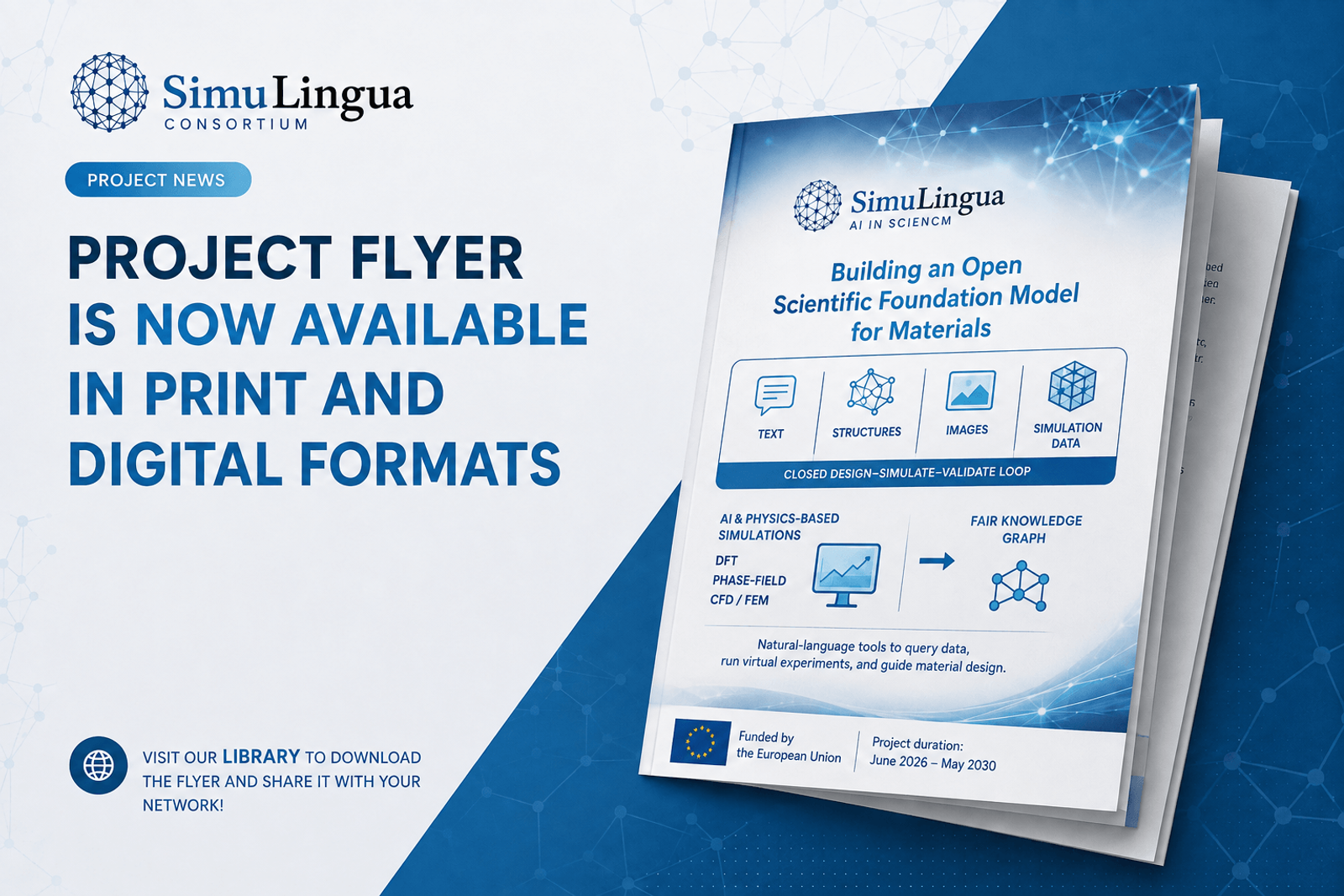
SimuLingua closes the design–simulate–validate loop: SciFM proposes candidates, fast surrogates verify plausibility and performance, and validated data flows back through a FAIR knowledge graph.
Open foundation model unifying text, structures, images and simulation data — Graphormer, SciBERT, and numerical encoders for >10 simultaneous prediction tasks.
View platform →Proposes candidates via staged constraint curriculum and conditional diffusion/VAE — synthesizability scoring from charge neutrality to CALPHAD-feasible windows.
View platform →New results flow back continuously — >10M entities, >15 sources, Data Gate audits, leakage-safe splits, and DOME-ML compliant provenance.
View platform →Domain experts query the KG, launch virtual experiments and steer multi-objective inverse design in plain language.
View platform →Surrogates carry calibrated uncertainty — deep ensembles, conformal prediction (ECE ≤ 0.05), hallucination-risk scoring, human-in-the-loop NLP UI.
View platform →Electroceramics, glass, high-entropy alloys, wire cladding, functional coatings, and digital olfaction arrays — six validation tracks.
View use cases →>50%
less time-to-discovery
10³×
simulation speed-up
9
consortium partners
Platform
An open multimodal SciFM unifying text, structures, images and simulation data — ingesting heterogeneous materials inputs and returning actionable predictions.
Text
Structures
Numerical
Images & fields
Property prediction & UQ
Generative inverse design
Synthesizability & routes
Cross-modal search
Impact
Consortium effort, use-case validation funnel, and platform release targets.
Person-months
Consortium effort across 20 work packages and 48 months.
9
Partners
Universities, SMEs, and one NGO across the value chain.
7
Countries
Norway, Sweden, UK, Netherlands, Ireland, Lithuania, Ukraine.
Knowledge graph entities
0M+Validation funnel growth
Consortium
Nine partners from seven European countries deliver the open multimodal SciFM, simulation pipeline and FAIR knowledge graph — validating six industrial use cases from electroceramics to sensor inks. FLOWPHYS coordinates; universities and industry partners cover modelling, data, formulation and experimental validation.
Validation
Six partner-led materials domains — electroceramics, glass, high-entropy alloys, wire cladding, functional coatings and sensor arrays — validate SimuLingua from in-silico discovery through physics-aware simulation to lab demonstrators.
Discover lead-free piezoelectrics, advanced dielectrics, and NTC thermistors to replace hazardous PZT and meet RoHS demands.
View UC1 profile →Design ultra-durable display glasses and low-loss electronic packaging glasses with tailored hardness, transparency, and dielectric properties.
View UC2 profile →Design high-entropy and refractory alloys for heat-pipe heat exchangers operating in oxidizing industrial gases at ≥1100°C.
View UC3 profile →AI-driven process robustness for wire-based laser and hybrid laser-plasma cladding — a digital twin that delivers consistent quality with variable recycled Al alloy feedstock.
View UC4 profile →Computational discovery, AI-driven screening, and optimisation of analyte-sensitive functional materials and printable ink formulations.
View UC5 profile →From tailored sensing materials to integrated 64×128 digital olfactory hardware with cross-reactive chemical fingerprint readout.
View UC6 profile →Horizon Europe
SciFM evolves from prototype to open-source release — compressing discovery cycles with physics in the loop.
V0
M18
50–100M params
Prototype — shake out modality encoders, fusion, and multi-task heads.
V1
M30
120–200M params
First stable KG slice — 8–10 prediction tasks, physics-informed generative module.
V2
M42
200–300M params
Final release — experimental feedback incorporated, open-source platform (D17.3).
Impact snapshot
Discovery
>50%
less time-to-discovery
Simulation
10³×
speed-up at <5% error
Generative quality
>80%
valid, synthesizable proposals
Technology readiness
TRL 1→4
in 48 months
Technology readiness
Target: TRL 1→4 in 48 months
Project updates subscription
Get milestones, publications, events, consortium news and other SimuLingua project information — straight to your inbox.
Project coordination
FLOWPHYS AS coordinates the Horizon Europe action. Reach out for scientific, consortium or press enquiries across our nine partners.
FLOWPHYS AS
Per Kjellgren · Project Coordinator
Oslo, Norway
View consortium partnersper.kjellgren@flowphys.com
General enquiries
contact@simulingua.eu
+47 40621185
Events
Conferences, workshops, and webinars where SimuLingua partners share progress and engage stakeholders.
More events coming soon
Future events will appear here.
More events coming soon
Future events will appear here.
More events coming soon
Future events will appear here.
More events coming soon
Future events will appear here.
News


 Norway
 Ukraine
 UK
UK
 Sweden
 Ireland

 Netherlands

 Lithuania